View the original article here.
INTRODUCTION
Turn-based strategy games used to be an alternative game type when the controls or performance of the platform it was played on made it difficult to play real time strategy games. Nowadays, though, turn-based strategy has become way more than an alternative; it's become a massively popular genre with phenomenal gaming titles and an enormous following of loyal fans.
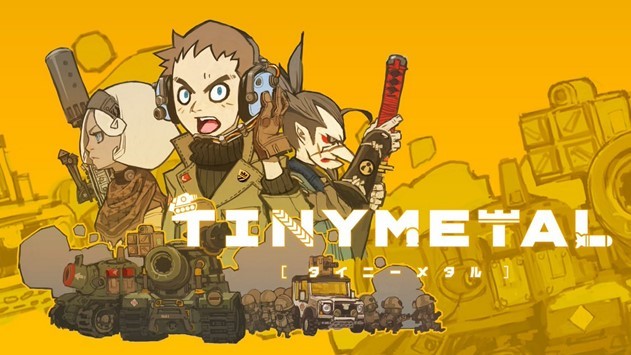
Tiny Metal takes you back to the olden days of turn based strategy by going back to the basics. Simple game mechanics and clean visuals mean that this is a game you launch and start playing without having to read through the developer's own, home made version of the Oxford Dictionary.
This game has been dubbed by some to be the spiritual successor to Advanced Wars, a fantastic turn based strategy game playable on the Nintendo DS. I played Advanced Wars years ago. I had a bunch of fun with it, and I definitely see why these two are seen as siblings. The only question is, does the back to basics routine employed by Area 35 give them access to some hungry part of the gaming market, or is this segment part of a long forgotten past, never to be revived again?
STORYLINE
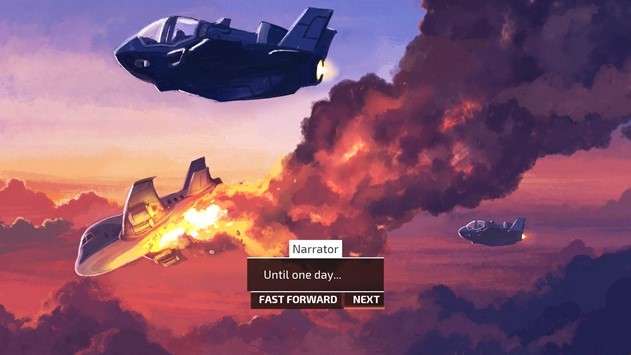
Things are not off to a good start. The story driving Tiny Metal feels as dragged out as it does cliché. You play the role of Lt. Nathan Gries of the Artemisian army. You set out against the Zipang nation who assassinated your king and you are soon joined by a mercenary group called the White Fangs who are also after Zipang for their own reasons.
The White Fangs are led by a young girl known only as Wolfram who will fight any war for the right price but doesn't ask you for any compensation for their help. It is soon made clear that she has ulterior motives for joining the fight but it's not yet clear what those are. (Spoilers ahead) During your conquests, you search for Col. Lindberg, your commanding officer, and mentor. Of course, when you find him you learn that he defected to the Zipangese (Yes, that's an actual word) and means to destroy the country you love because of some ideological nonsense. I distinctly remember seeing this movie before.
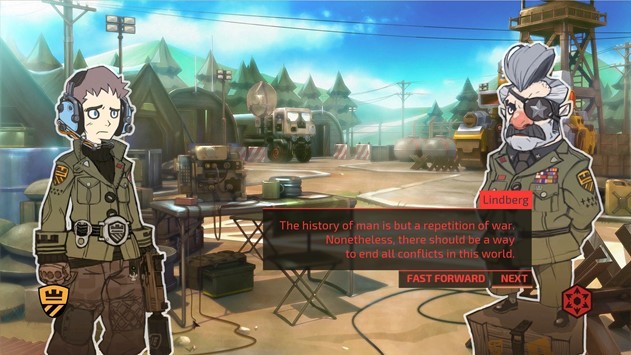
To exacerbate the situation even further, the conversations between the characters are incredibly drawn out and seem to circle each subject way longer than is necessary. It feels like a bad anime. You know exactly what's going to happen, the characters are shallow and uninspiring and an event that should be over in a few minutes takes 12 episodes.
Furthermore, the tutorial is worked into the story. This by itself is a good thing because it means you don't need to read through pages of how-tos and instead pick up what to do as you go through the game's script. Unfortunately, the bad writing continued here.Have you ever watched a TV advert of a mundane product, featuring two people sitting in an everyday situation, discussing said product, in a way that gives out all the vital information you as a consumer may need while trying to appear as if discussing the fact that your favourite insecticide now comes with a lemony-fresh scent to your friends and colleagues is normal behaviour. That's exactly how the tutorial plays out.
GAMEPLAY
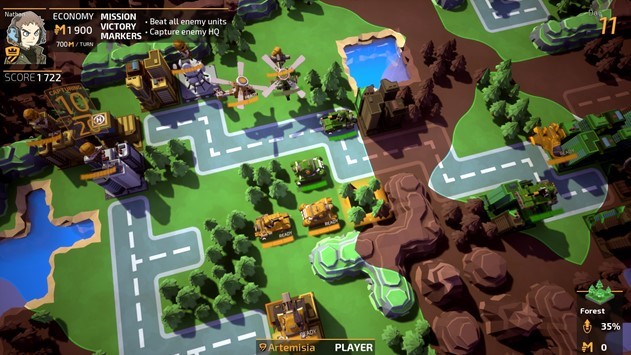
In true turn based fashion, you move your army around a chequered map and try to outwit your opponent. You'll start each round with a number of units and can capture certain buildings to help you replenish your forces. Capturing requires you to move any infantry unit onto that square and spend the needed amount of turns performing the "Capture" command. The most common structures you capture are cities which, when owned by your team, provide you with income every turn and can serve as a healing station for infantry although not armored units. The funds you earn can then be spent on new units to be purchased from factories and airports.
There are also buildings called Comm-links which allow you to call in specialized versions of the units you have available but only one of each of these can be recruited in a match. Finally, you have other structures which your soldiers can explore to reveal some sort of intel. This sounds all dandy, but I often stumbled across such a building, explored and was given information I no longer needed, such as the location of my objective which I already found or the blueprints to building Fighter Jets, a unit I started producing two missions prior. This game endorses the words of actor Danny Devito when he said that military intelligence is a good example of an oxymoron.
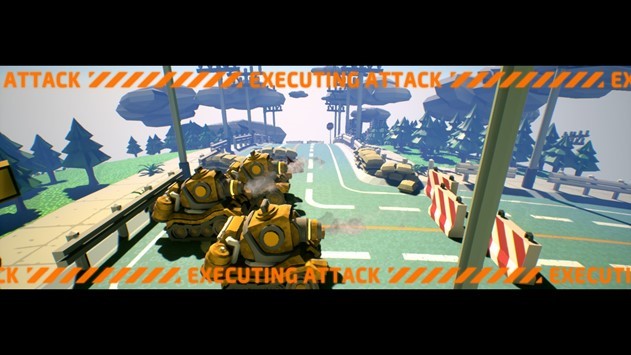
There are also bigger, badder and more expensive versions of some of the units I've already mentioned. They usually have more firepower and thicker armor but less mobility. In some cases, the lack of mobility is so severe that the unit becomes unusable. I once built two of the upgraded Strikers during one mission and only used one of them once the entire game, simply because they couldn't move quick enough to get to the action.
As far as actions go, once again things have been simplified as much as possible in that you can only move and attack. Assault is an alternative attack option that lets the enemy fire first but forces them to move back one square afterward, and you can also order units to lock on an enemy which means they'll attack in unison with another unit later. Attacking your enemies is all good and well, but I would have liked special abilities of some sort to spice things up. Most actions earn your units experience points which gradually upgrades them in various ways but honestly I rarely even noticed this mechanic.
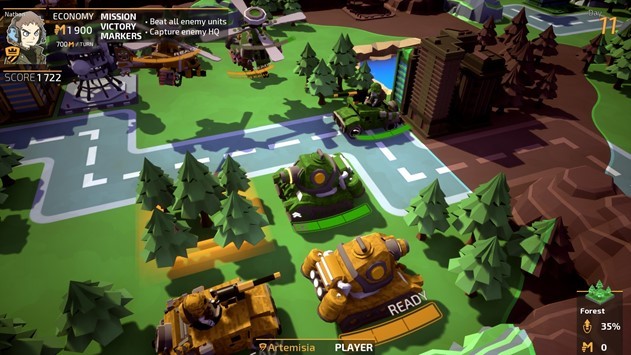
So much for the bland, let's get into the broken. The game is incredibly easy, even as a new player who made several obvious mistakes in some of my missions, I was never in trouble, and this can't be changed because the game has no difficulty setting. Moving around doesn't require you to scroll to the edge of the screen as you'd expect; rather, the screen follows your cursor. In theory, this could be a good idea, but too often I found the angle at which I was viewing things awkward and whenever I moved my mouse, things would jump around unexpectedly. Another problem with this view is that while there's an option in the menu to jump to the next available unit, a moment after jumping, the screen freezes again to focus on your cursor, leaving you to search the battlefield for that one soldier who hadn't received any orders.
As mentioned, you can heal your infantry units by garrisoning them inside captured cities. However, your armored units can't be repaired, leaving them to carry on fighting regardless of their status, and after their health dips below the halfway mark, they really become worthless and are only in the way. Furthermore, flying units' movement is actually limited by the landscape. Fighters serve as fantastic recon units because of their high mobility, just don't expect them to fly over a river because they'll have to stop halfway for a nap. The biggest bug I found though was the lack of "Back" button when entering the in-game "Metalopedia" which had me force quit the game to get back to where I was.
That said, the issue that bugs me the most is the fact that there is no "End turn" option, instead, the turn ends automatically when all your units and structures have been issued commands. This means that in every turn, you have to scroll through every single unit and production building to give an order or tell them to do nothing before you can proceed.
DESIGN
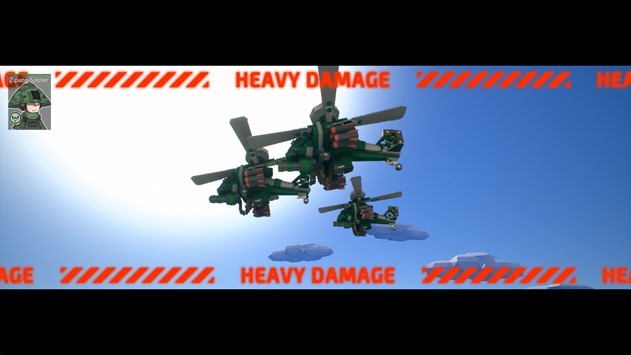
As far as the visuals go, I'm once again reminded of the handheld consoles of yesteryear. Area 35 have opted for crystallized models for the units and terrain which does hold a certain humorous charm but certainly won't be winning any awards. When performing an attack you are treated to a zoomed in animation of the attacking and defending units which I rather enjoyed, although some of the animations could use some polishing.
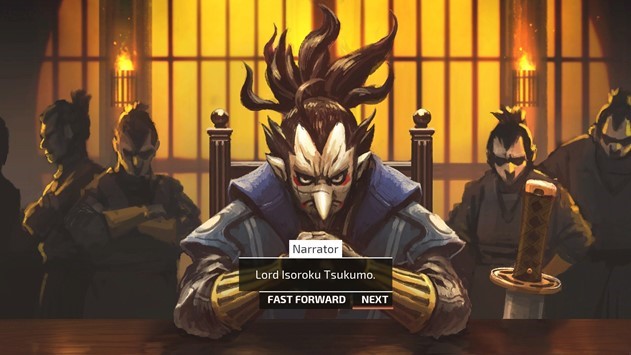
Audio had me somewhat baffled at the start because the narration and cutscene dialogue were in Japanese, despite English being selected as the default language. You do get a written account of everything that was said though, and then as soon as you enter a match, the units respond to your commands in English.
CONCLUSION
Having heard this game being called a spiritual successor to the widely popular Advanced Wars, I was ready to love Tiny Metal. I didn't.
This is the sort of game I'd play on my smartphone, not a state-of-the-art gaming console or PC, and certainly not one I'd pay $25 for. Yes, the simplicity of it all does give you some sense of nostalgia, but that's not enough to make up for the fact that this game is in fact, boring.
Keep in mind though that it's still in development, and hopefully, it'll stay there for a while longer while the developers iron out the kinks and make the important bits shine. There is definitely something there, buried deep underneath layers and layers of blandness.
I haven't lost hope on Tiny Metal yet, but right now I'm craving more. This is by no means a bad game, it's just not good either.
| Pros | Cons |
|---|---|
| Fantastic voice acting | Various unit types, none of which stand out |
| A quick glimpse into a glorious past | Uncomfortable cursor following screen movement |
| Easy to pick up and go | No "End Turn" button |
| Slow, cliché storyline | |
| Nothing more than ordinary |