View the original article here.
INTRODUCTION
Oriental Empires is a 4x strategy game that sets you in ancient China and lets you lead your empire through various eras, onto greatness or ruin. During these treacherous times, you will grow your populace, found new cities, construct buildings to contribute to your economy and fight countless wars to claim your rightful place in history.
It's immediately apparent where Shining Pixel Studios got their inspiration for Oriental Empires. From the get-go, you'll notice several elements taken directly from Sid Meier's Civilization series. However, while many of the base mechanics might seem like cheap knock-offs from Civilization, Oriental Empires adds some additional features which I haven't seen in another game in this genre.
Many comparisons can be made here, but I believe Oriental Empires does enough to stand out from other, better-known games. The only question is whether those elements make Oriental Empires a better game or not?
GETTING STARTED
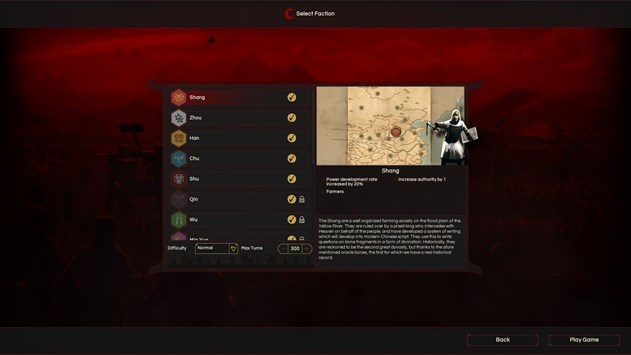
As I start a new campaign I'm presented with a huge list of clans I will be able to play as. Only 5 of these are available initially with the rest being unlocked as soon as 200 turns are played in a single game. I suspect this is just so new players aren't immediately overwhelmed when starting their first game.
I have a quick read through the various factions I have available and try to guess which of the unique attributes will suit me best. I settle for the Shang clan since they seem to be more rounded and should provide the most balanced experience for a first game, even though I don't understand most of what I'm reading.
GAMEPLAY
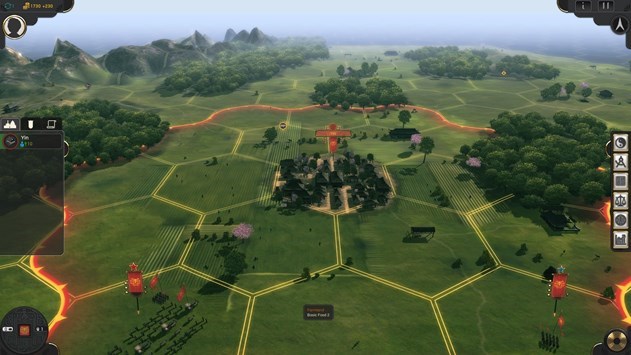
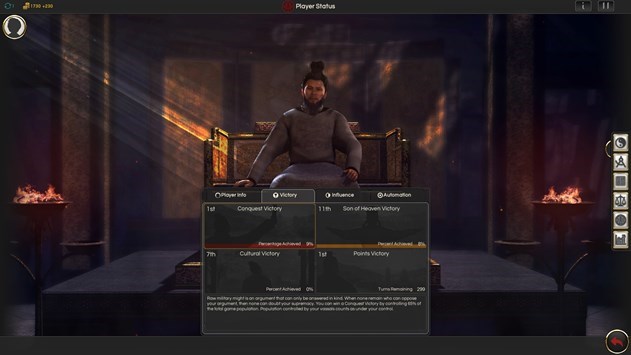
Civilization fans will find a number of familiar game mechanics in Oriental Empires such as the hexagon map, the borrowed trade system between empires, tile improvements around cities and the list of victory conditions, among others. That said, it's also lacking many of the elements that have made Civilization so successful.
The most important feature that makes Oriental Empires different in my opinion is that instead of giving each faction a turn and having them move their units one by one, you rather plan your entire turn first and then see how it all unfolds when you end the round. This makes combat especially intricate since the enemies' movements are that much harder to divine. I would send my armies in a direction, thinking they'll meet a foe head on, only to discover that my opponent split his armies and had them outflank mine. This combined with several combat options at my disposal, like switching battle strategies from offense to defense or harass and rearranging the formation of my troops meant that waging war was significantly more challenging than I expected.
Searching through the map, you'll see various icons that indicate a possible meeting to take place should you enter that tile. This is the main reason to start exploring early since you'll come across some nice deals this way but will only be rewarded if you get there first. Generally, these tiles merely present you with an option to improve some aspect of your faction at the cost of gold but these benefits can be quite useful, like revealing a large portion of the map or showing you the location of valuable resources in the area.
Obviously, you can't just oversee the landscape and at some point, you'll need to have a look at your cities individually to make sure they're all doing their part to ensure your victory. The city management screen provides you with heaps of information regarding the city's finances, population, labor pool, unrest, and food production. Unfortunately, it's not clear how knowing any of this information benefits you or how you can manipulate them. For example, unrest is divided between the nobles and peasants. You are given a list of reasons why your city is experiencing unrest, like having founded too many cities and not having enough authority to control them. However, the largest source of unrest is usually "Local factors" which the game informs you that you "can't do much about". So essentially, your citizens will always be grouchy, and you can't do squat to rectify the situation. This seems like a half-baked attempt to balance things.
Construction and recruitment work in similar fashion to Civilization although recruiting new units is slightly different in that the unit is available immediately and you are then given a timer showing how many rounds need to pass before the city's youth will have matured enough to become replacement troops. There are a fair amount of structures available in the game but only a set number can be built in each city. This limit is less restrictive than I initially thought since building maintenance is so high you tend to build only what is absolutely necessary to avoid going bankrupt. If you find your finances overextended then all that's really left to do is to destroy some of your buildings to free up some capital and provide some relief to your turnly income. Overall the city management portion of the game felt like an afterthought next to the complex battle system. You constantly have to check in on your cities to see if there are any problems that need attending to but most resolutions require something to be built and as mentioned, that simply costs too much so you end up doing nothing. I went through way too many turns looking around, seeing problems and not knowing what to do about them, only to repeat that process again the next turn. The trend seemed to be that if you're not at war then you're not doing much. The excess focus on culture and authority once again emphasized that the game's development was focused more on combat than management since there are numerous other factors a game like this could have utilize to make things more interesting.
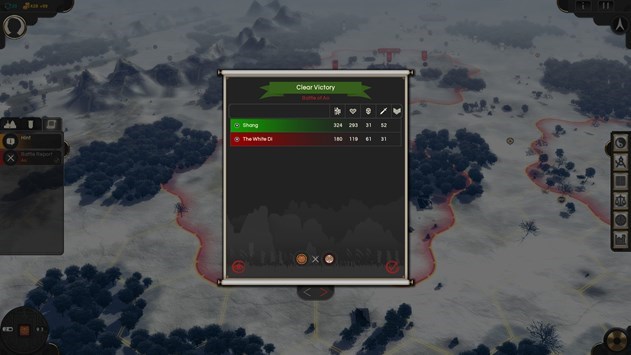
Even in straight up fights, I was left baffled by the outcomes. It truly seemed like the outcome of a battle was decided purely by chance and not by strategy or even superior troop numbers. I'd send several armies to attack a single battalion only to suffer a humiliating defeat. On the flip side, I often had Chuck Norris hide among my soldiers, that's the only way I can explain how 40 soldiers could kill 80 enemies while the opposing force which consisted of over 200 only managed to kill 6 of my own.
I also mentioned that battle plans are made first and then left to execute all at once. This is a feature I've seen used to great success in a digital version of Risk, the world domination board game, but in Oriental Empires it mostly had me chasing my enemies around in circles. Keep in mind also that battles aren't won or lost in a single round. Armies can continue fighting countless battles since the strangely randomized outcomes could have a large army suffer only single digit losses at a time. This means that battles are not only frustrating but also take forever to complete. I was looking forward to the unique combat mechanics being the one thing that made this game worth coming back to but it ended up being frustrating, confusing and downright annoying. Oriental Empires will feature a multiplayer option when the final release is made available. I was given access to this feature with an opportunity to take on the developers in a friendly match, a fine and rare gesture but unfortunately, one I was unable to utilize due to time constraints.
DESIGN
Despite the various shortcomings in gameplay, Oriental Empires manages to stand out quite a bit in terms of design. They might lack any form of voice acting but the soundtracks included in the game do a fantastic job of setting the scene. The Asian themed music is rather beautiful and strikes a good balance between being distinct and simply coloring in the background. Too often I find myself muting background music in games, Civilization being one such case, but the soundtracks in Oriental Empires never drove me to that point.
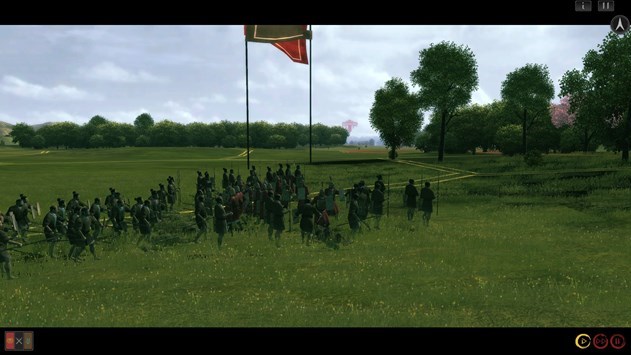
The visuals are similarly impressive. Initially, you have a top-down view of your empire which lets you see everything that might be important. But, you can also scroll in close to see how your citizens interact with their surroundings and you can get a front row seat to all the glorious fighting. Obviously, you won't be spending a lot of time zoomed in since that doesn't promote gameplay in any sense, which is a good thing when you realize how stiff the animations are. Nonetheless, this is still a nice feature to have.
However, while the game looks pretty, the visuals do lack variety. Too many things look the same and this is demonstrated perfectly when meeting and requesting an audience with other faction leaders. The game includes a template or two but most of the opposing leaders end up looking nearly identical.
The biggest drawback with the design is the user interface. As you can expect from a game like this, there is a lot of information that should be readily available for the player to know what's going on, and putting together a UI with so many elements in a way that's both effective and user friendly must be a daunting task, a task the developers failed at miserably here. Most of the items on your screen are way too small and don't provide any sense of what they are for until you mouse over them and read the tooltip. There is also no mini map and even the notifications tab fades uselessly into the background which means you consciously have to open it up to view your notifications from the previous round or risk forgetting it altogether.
CONCLUSION
Oriental Empires left me wanting so much more. There is a fantastic amount of potential locked away here but unfortunately, there's still too much polishing to be done before this will be a worthy alternative to other games out there.
The game might look and sound good but a badly designed interface lets it down. As far as gameplay is concerned, the best parts are those that have been copied from other franchises while the unique mechanics featured here simply don't work. I admire them for trying to bring their unique elements into this genre but the sad reality is that they need to evolve even further for these elements to matter.
I'm a huge fan of 4x strategy games, and the Civilization series in particular, which is probably why this game fell so far short for me; I'm used to better. That said, Civilization has spent the past 2 decades improving and perfecting itself. Take that into consideration and suddenly Oriental Empires is not a bad first attempt, and if the developers ever choose to follow up with Oriental Empires 2, I'll probably be first in line to get it. For now though, I'm left thoroughly unsatisfied.
| Pros | Cons |
|---|---|
| Beautiful visual and audio design | Lack of decent tutorial |
| An attempt at being different | Non user-friendly UI |
| Underdeveloped game mechanics |